Pavlova (Crisp Meringue Shell, Chewy Marshmallow Center)

Pavlova is one of those desserts that looks like it came from a patisserie window, with a cloud of crisp meringue piled high with whipped cream and jewel-toned fresh fruit. What most people don’t realize is that the showstopper on the plate comes down to one fundamental skill: knowing how to whip a proper meringue. That technique is what creates the signature contrast of a crisp shell that gives way to a chewy, marshmallow-soft center. Nail the technique, and you’ll impress your guests every time — and yourself in the process.

Plan Ahead for Pavlova
Pavlova is a light and airy meringue dessert that has earned its place in my homemade dessert recipe collection, but it’s not a weeknight dessert. The hands-on mixing takes about an hour, followed by an hour and a half in the oven and 6 hours of cooling. If you can make this a day or two in advance, I recommend doing so. Just save the decorating for right before serving, and you’ll be good to go.
What You’ll Need
For the pavlova base, you need just three things: egg whites, superfine sugar, and an acid like vinegar or a juicy lemon or lime. I recommend measuring the egg whites and sugar by weight to ensure that you have exactly the right ratio. Don’t have a scale? I’ve included volume measurements too.

Featured Ingredient: Egg Whites
Egg whites, the clear part of an egg, are mostly water and protein, which expand dramatically when whipped to form a stable, airy foam. This whipped structure is the foundation of any pavlova, giving it that perfect balance of crunch on the outside and a chewy, marshmallow-like texture inside.
How to Make Pavlova
This pavlova comes together in three stages. First we build the meringue, then it needs time to bake and fully dry out, then comes decorating. That first step — making the meringue — is the most critical.
- Prepare the mixing bowl. Dip a towel in vinegar or use the cut side of a juicy lemon or lime to rub down the entire surface of your mixing bowl and beaters to remove any grease or residue. It also adds a small amount of acid to the meringue mixture, which helps stabilize the egg whites.
- Preheat the oven to 300ºF.
Making the Meringue


Bake the Meringue
- Bake. Place the pavlova in the oven and immediately turn the heat to 225ºF. Bake for one and a half hours.
- Cool and Dry. Once fully baked, turn off the heat and leave it in the oven with the door slightly ajar for at least 6 hours, or up to overnight.
Pavlova Topping and Decoration
Once the pavlova is baked and fully cooled, it’s time to decorate it with whipped cream and fresh fruit.


Kitchen Skills: Meringue
In this easy pavlova recipe, I use the Swiss method: superfine sugar is gradually added to whipped egg whites and beaten until stiff peaks form. The result is a beautiful, glossy meringue with a satisfying texture that’s crisp on the outside and soft within.
Curious about the different meringue techniques? Check out my Ultimate Guide to Meringue Types and Techniques to learn about Swiss, French, and Italian meringues.
Tips for Pavlova Success
- Separate the egg whites from the egg yolk when cold, then allow the whites to warm to room temperature for best results.
- Don’t rush adding the sugar. It’s important to add the sugar one tablespoon at a time, otherwise you can end up with a leaky or cracked meringue. This step will typically take 15 to 20 minutes.
- How to tell when the meringue is ready. Whisking the meringue is a lengthy process, but if you rush it, the meringue might fail. Once all of the sugar has been added, it may take an additional 20 minutes or more to achieve the thick, glossy mixture. To check if it’s done, rub a small amount between your thumb and forefinger. If it’s smooth, then the meringue is ready, but if you feel grains of sugar, keep mixing.
- Don’t open the oven door while baking. Once the pavlova is placed in the oven, avoid the temptation to open the door.
- Allow it to cool in the oven with the door cracked. This will allow the baked pavlova to dry out completely and prevent cracking.

Serving Suggestions
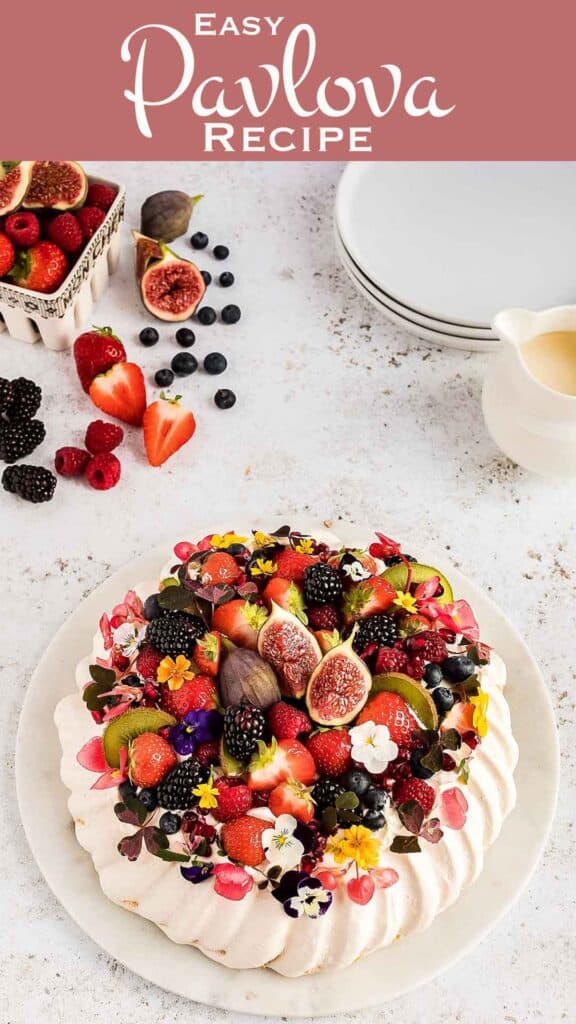
Pavlova is typically served with a freshly made whipped cream topping and piled high with fresh in-season fruit. For this recipe, I added powdered sugar and vanilla to the whipped cream topping to make a sweetened vanilla whipped cream.
While the fresh berries and figs in my photos are great for summer, you could also use sliced persimmons and pears in the fall, candied cranberries for a Christmas dessert, or a layer of lemon curd and edible flowers in the spring. Once decorated, enjoy the pavlova immediately, as it will start to soften.

How to Store Leftovers
An undecorated pavlova will stay fresh in an airtight container for a couple of weeks at room temperature. However, once it is decorated, it will need to be stored in the fridge due to the fresh cream topping.
A decorated pavlova will not keep well at all. The added moisture from the whipped cream will cause the crisp exterior of the pavlova to soften, making the whole dessert wilt. The best pavlova is the one you eat the day it’s decorated.

Pavlova (Crisp Meringue Shell, Chewy Marshmallow Center)
Ingredients
Pavlova Base
- lemon juice, white wine vinegar, or apple cider vinegar
- 180 grams egg whites (approx. 6 large egg whites)
- 360 grams superfine sugar (aka baker’s sugar or caster sugar | 1 3/4 cups)
Pavlova Topping
- 1 cup heavy whipping cream plus extra for serving (8 ounces)
- 3 tablespoons powdered sugar
- 2 teaspoons vanilla extract
- Selection of fresh fruit to decorate
- Edible flowers (optional)
Instructions
Pavlova Base
- First make sure your mixing bowl and whisk are spotlessly clean. Wipe them with white wine vinegar, cider vinegar, or the cut edge of a fresh lemon to make sure there is no grease on them and to add acid to the egg whites.
- Preheat the oven to 300ºF.
- Add the egg whites to the bowl of a stand mixer and whisk on a low speed until they reach soft peaks. This can take 8-10 minutes.
- Remaining at a low speed, add the sugar to the eggs one tablespoon at a time allowing the sugar to fully dissolve in-between each addition. Scrape down the bowl with a plastic spatula a couple of times during this process.
- When all the sugar has been added, increase the speed to medium and keep whisking until you have a very thick and glossy white meringue.
- Draw an 8” (20cm) circle on a piece of baking parchment then flip the paper over and put it onto your baking tray.
- Pile the meringue into the middle of the circle. Use a palette knife to spread it evenly then use the knife to drag up the sides of the meringue to form the pavlova.
- Use the back of a spoon to make a well in the top of the pavlova.
- Put the pavlova into the oven and immediately turn the heat down to 225ºF.
- Bake for 1.5 hours without opening the oven door, then turn the heat off and leave the pavlova in the oven with the door slightly ajar for 6 hours or overnight. This will allow it to dry out completely and prevent cracking.
Pavlova Topping
- When you’re ready to decorate, add the heavy cream, powdered sugar and vanilla extract to a mixing bowl and whisk to soft peaks.
- Add the whipped cream on top of the pavlova then decorate with fresh fruit.
- Serve with a drizzle of runny cream if desired.
Recommended Kitchen Tools
We are a participant in the Amazon Services LLC Associates Program. As an Amazon Associate I earn from qualifying purchases. Check out my Amazon shop to see all of my recommended kitchen tools.
Notes
- If you can’t find superfine sugar, you can substitute it with granulated sugar; however, it will take longer to dissolve.
- The egg whites are at soft peaks when they leave a trail (or small peaks) in the mixing bowl when you lift the beaters up.
- It can take 15-20 minutes to add the sugar one tablespoon at a time. It’s very important to do it slowly because if the sugar is not properly dissolved, it can lead to a leaky or cracked meringue.
- Once all the sugar has been added to the eggs it can take a further 20 minutes or longer to turn into a thick and glossy mixture. You can check if it’s done by taking a small amount of the mixture out of the bowl with your thumb and forefinger. Rub your fingers together – if it’s smooth, then the meringue is ready, but if you can still feel some grains of sugar, then it needs to be mixed further.
- An undecorated pavlova can be kept in an airtight container for a couple of weeks. Once decorated, it will have to be refrigerated to preserve the fresh cream. The pavlova will soften in the fridge so this dessert is best eaten on the day it is made.
Nutrition
Nutrition information is automatically calculated and is for general information purposes only. For the most accurate information, calculate using your select brands and exact measurements.
Like this recipe?
If you made this recipe, please leave a star rating along with a comment below — it helps other readers know what they are getting into before they start. (Five stars is the best!)
Made this for a party and it was a hit! I loved how simple it was to make!
I’m so glad it was a hit!! Thanks for coming back to comment.
Wow, this Pavlova recipe looks amazing! I just tried it the other day and it turned out incredible! The meringue was so light and airy, and the whipped cream and fruit topping were the perfect finishing touch. Definitely a new favorite dessert! Thanks for sharing!